SOAP vs DAP vs BIRP Notes: Which Documentation Format is Best for Play Therapists?
If you’ve ever stared at a blank progress note after a play therapy session wondering “Where do I even start?”, you’re not alone.
Documentation can feel especially challenging in play therapy because our sessions often don’t follow a neat, predictable structure. Children communicate through play, relationship, creativity and behaviour rather than simply telling us what they think and feel.
This is where documentation frameworks like SOAP, DAP and BIRP notes can be helpful. These formats provide a structure for organising your clinical thinking while still allowing space to document the unique nature of play therapy.
But which format should you use? The answer depends on your workplace or regulatory body requirements (check with your supervisor if you’re unsure!), your clinical setting, your theoretical model, and the way you prefer to organise your observations.
Like me, you might want to try each one out and see which format works best for you.
Now, let’s explore the differences.
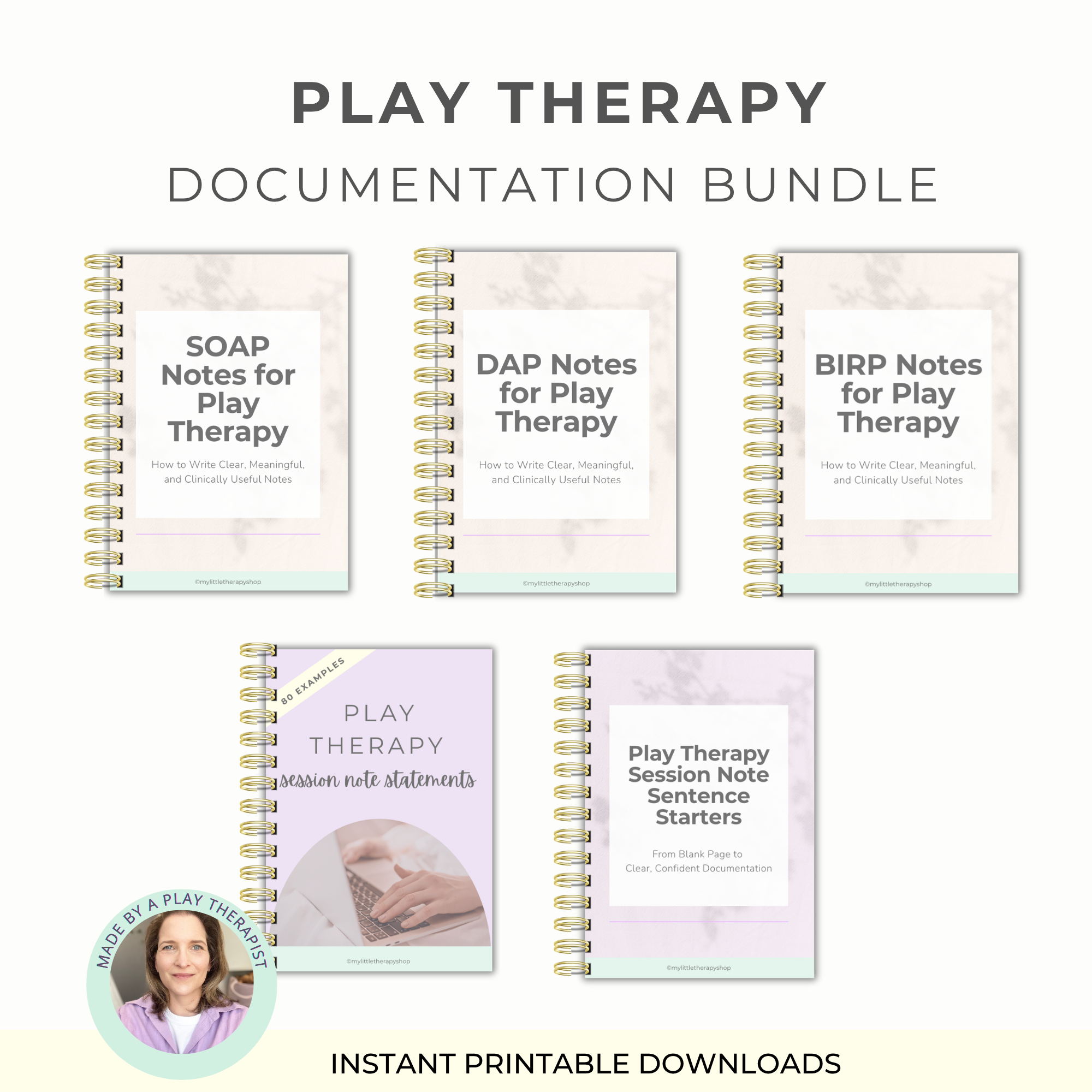
(Psst: my Session Documentation Bundle has complete session note writing guides and case note examples.)
What are SOAP, DAP and BIRP notes?
SOAP, DAP and BIRP are different formats for organising therapy progress notes. Essentially, they all aim to capture similar things:
What happened during the session
What you observed
Your clinical understanding
What happens next
The difference is mainly how that information is structured.
SOAP notes for play therapy
SOAP stands for:
S — Subjective
O — Objective
A — Assessment
P — Plan
SOAP notes are one of the most widely recognised documentation formats across healthcare settings.
Subjective
This section captures information reported by the client, caregiver or others involved. In child therapy, this may include:
caregiver updates
changes at home or school
the child’s reported experiences (where developmentally appropriate)
concerns shared before the session
Here’s an example: "Caregiver reported increased difficulty with morning routines and emotional outbursts following recent changes at home."
Objective
This section documents observable information. For play therapy, this might include:
the child's presentation
engagement with the therapist
play behaviours
communication
emotional expression
interactions within the playroom
Here’s an example: "Client entered the playroom independently and engaged in imaginative play involving family figures and rescue scenarios."
Assessment
This is where you document your clinical interpretation and therapeutic observations. You might include:
emerging themes
progress towards goals
patterns observed over time
clinical hypotheses
Here’s an example: "Themes of safety and caregiving continue to emerge. Client demonstrated increased tolerance for frustration during challenging play experiences."
Plan
This outlines the next steps, such as:
continue play therapy
monitor emerging themes
schedule parent consultation
continue working towards identified goals
SOAP notes may suit therapists who:
work in multidisciplinary settings
need a structured healthcare format
prefer clear separation between observations and clinical assessment
DAP notes for play therapy
DAP stands for:
D — Data
A — Assessment
P — Plan
DAP notes are often popular because they are a little more concise than SOAP notes. In fact, these have become my go-to for documenting my play therapy sessions: they’re quick while capturing all the essential bits.
Data
This includes the information gathered during the session. For play therapists, this may include:
presentation
play observed
interactions
caregiver updates
therapist responses
Here’s an example: "Client engaged in imaginative play using miniature figures. Repeated themes of rescuing and protecting emerged. Therapist reflected feelings and tracked the client’s play throughout the session."
Assessment
This section captures your clinical understanding. For example:
"Client continues to explore themes related to safety and control. Client demonstrated increased ability to remain engaged following moments of frustration."
Plan
Just like SOAP notes, this outlines what happens next. See above for an example.
DAP notes may suit therapists who:
prefer concise documentation
want flexibility to capture play themes and clinical reasoning
like combining observations and session information into one section
BIRP notes for play therapy
BIRP stands for:
B — Behaviour
I — Intervention
R — Response
P — Plan
BIRP notes place a strong focus on what happened in the session and how the client responded to therapeutic interventions.
Behaviour
This describes what you observed. For play therapy, this might include:
presentation
play behaviours
emotional expression
interactions
For example:
"Client entered the room hesitantly and initially remained close to the doorway before moving towards the sand tray."
Intervention
This describes what you did as the therapist, such as:
tracking
reflecting feelings
facilitating choices
therapeutic limit setting
supporting emotional expression
introducing strategies, play ideas or activities
Here’s an example:
"Therapist used tracking and feeling reflections to support the client’s exploration of emotional themes."
Response
This section captures the child's response.
For example:
"Client continued engaging in play and expanded the story after therapist reflections."
Plan
Yep, you got it. This section simply documents the next steps, like:
"Continue play therapy and monitor emerging themes across sessions."
BIRP notes may suit therapists who:
prefer documenting the connection between therapeutic intervention and client response
work in settings where demonstrating treatment processes and outcomes is important
use structured, directive, integrative, or relational approaches and want a clear way to capture what occurred during the session
Free play therapy session note examples
If writing play therapy notes still feels overwhelming, I've created a free resource with practical examples of how I document play therapy sessions.
Inside you'll find examples phrases for client transitions, engagement, regulation, emotional expression, play therapy themes, limit setting and more.
Looking for play therapy documentation templates?
If you’d like practical paperwork, templates, forms and documentation tools to help your practice run a little more smoothly, check out these private practice paperwork resources.
Whether you're just starting out or looking to streamline your paperwork, having a consistent documentation framework can save time, support clinical reasoning and make supervision and report writing much easier.
You might like to get started with the Session Documentation Bundle. It includes writing guides, example phrases, and full case notes for play therapy SOAP notes, DAP notes, and BIRP notes.