How to Write Play Therapy Session Notes (Without Mentioning Every Single Little Thing That Happened!)
I can still remember writing my very first session note for my very first play therapy client. I say note, but what I really mean is ‘novel’. Unsure about what to document and scared to miss any meaningful moment, I ended up writing a lengthy play-by-play of everything that happened right down to when my client took a breath or picked their nose. OK, it probably wasn’t that detailed, but it came pretty close!
So if you've ever sat staring at your computer after a play therapy session wondering, "How on earth do I document that?" please know that you're not alone.
Writing play therapy session notes can feel surprisingly difficult. Unlike directive therapies, child-centered play therapy often doesn't have obvious worksheets, goals, or conversations to summarise. Instead, you're documenting themes, therapeutic process, relationship building and clinical observations – all while taking care not to over-interpret your client’s play. Oof!
The good news? Your notes don't need to capture every minute of the session. They just need to tell the clinical story.
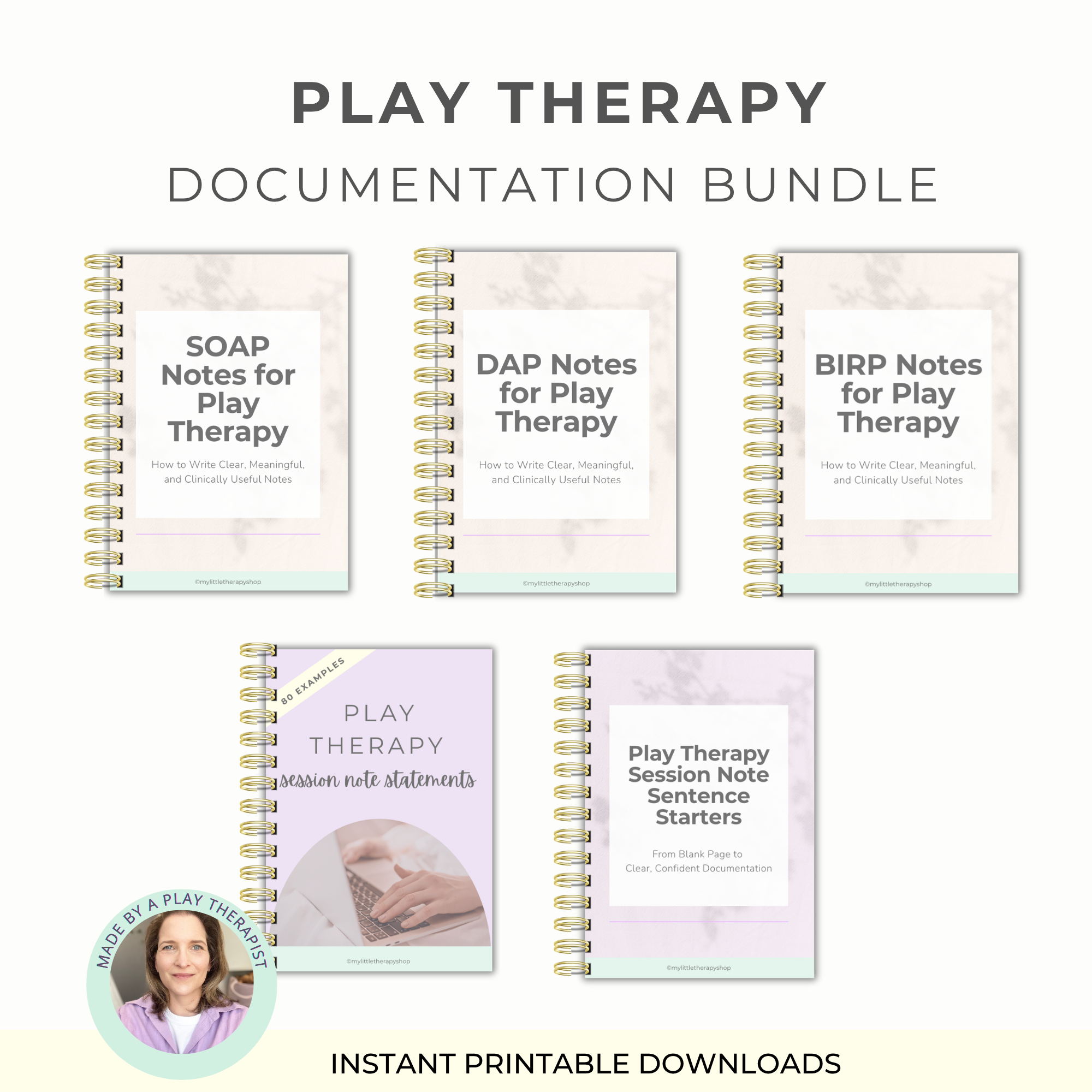
(Psst: my Session Documentation Bundle has complete session note writing guides and case note examples.)
Why are play therapy progress notes so hard?
If you're new to play therapy, you may have noticed that documenting sessions feels very different to documenting talk therapy.
Children don't usually tell us exactly how they're feeling. Instead, they communicate through play, relationships, behaviour, creativity and symbolic expression.
That means your notes often need to capture:
the child's emotional presentation
recurring play themes
the therapeutic relationship
significant interactions
developmental observations
your therapeutic responses
emerging clinical hypotheses
Rather than trying to describe every toy the child touched, your goal is to document the clinically meaningful parts of the session. Think quality, not quantity.
What should a play therapy session note include?
While every workplace and funding body has different documentation requirements (ask your supervisor or association if you’re unsure of your obligations) most play therapy notes include the following sections.
1. Session information
Start with the basics. You might include:
Client’s name
Date
Location
Session number (e.g. ‘10’ if the client has seen you 10 times)
Who attended (e.g. child only, caregiver present for part of the session)
Change in circumstances/need to know (any factors that may have influenced the session such as a shortened appointment, school visit, telehealth session, or significant updates shared by the caregiver)
This provides the context before you move into your observations.
My little tip: If you have regular caregiver review sessions, it can be helpful to track how many play sessions remain before your next parent update. For example, I write 1/5" after a session to remind myself that this is the first of five play sessions before the next caregiver update. That way, I know there are four more sessions before it's time to schedule the parent call.
2. The child’s presentation (how did they engage?)
Describe how the child presented at the beginning and throughout the session. Rather than writing "happy" or “excited”, consider documenting observable behaviours instead.
For example:
entered confidently and separated easily from caregiver
initially hesitant before engaging in exploratory play
sought frequent reassurance
displayed high levels of movement throughout the room
transitioned between activities with ease
demonstrated frustration when limits were set
The aim is to describe what you observed, rather than making assumptions about internal experiences.
3. The child’s play (what happened?)
One of the most common questions new play therapists ask is: "How much of the play do I actually need to document?" And it’s probably a lot less than you think!
Your session notes don't need to describe every toy the child touched or provide a minute-by-minute account of the session. Instead, focus on the parts of the play that were clinically meaningful or helped tell the story of the session.
It can be helpful to briefly note the types of play or categories of toys the child engaged with. For example:
Family and nurturing play
Aggressive or conflict play
Construction and building
Creative or expressive play (e.g. art, music)
Fantasy or imaginative play
Sensory play
Miniature world play
Games with rules
Mastery or challenge-based play
Then ask yourself:
Did the child return to the same type of play repeatedly?
Was there a noticeable shift in the play during the session?
Did a particular toy, interaction or sequence seem especially significant?
Did the play reflect something important about the child's emotional state, relationships or developmental level?
So rather than writing: "Played with the dollhouse, then Lego, then sand tray, then dinosaurs, then drew a picture” you might write: "The child spent much of the session engaged in nurturing family play, later transitioning into construction play where repeated rebuilding followed moments of frustration."
This gives a much clearer clinical picture while keeping your notes concise.
Remember, your goal isn't to document everything the child did. It's to capture the aspects of the play that help explain the therapeutic process and support your clinical reasoning.
4. Significant play themes (what patterns emerged?)
One of the most valuable parts of a play therapy note is identifying emerging play themes. Depending on your theoretical approach, these might include themes such as:
power and control
nurturing and caregiving
mastery
safety and security
rescue and protection
aggression
family relationships
separation
burying and drowning
Rather than over-interpreting a single session, notice recurring patterns over time. For example:
"The child repeatedly returned to rescue play involving trapped animals, with themes of protection and safety emerging throughout the session."
Recording themes allows you to track therapeutic progress across multiple sessions rather than viewing each session in isolation.
5. Therapeutic responses (what did you do?)
You don't need to document every reflection you made. Instead, summarise the interventions that were clinically significant. Depending on your approach, this might include:
tracking behaviour
reflecting feelings
facilitating choice
returning responsibility
therapeutic limit setting
supporting emotional expression
strengthening the therapeutic relationship
For example:
"Therapist used tracking, feeling reflections and therapeutic limit setting to support emotional expression while maintaining emotional and physical safety."
6. Clinical observations (what did you notice?)
This section captures what you noticed as a clinician. Examples may include observations relating to:
emotional regulation
sensory preferences
attachment behaviours
frustration tolerance
flexibility
problem-solving
transitions
social interaction
capacity for symbolic play
These observations become especially valuable when reviewed across multiple sessions.
7. Plan for next session (what’s next?)
Finish with a brief clinical plan. For example:
Continue child-centred play therapy.
Continue observing for themes relating to control and mastery.
Schedule parent consultation to discuss co-regulation strategies.
Monitor transitions and emotional regulation over coming sessions.
A few little things to avoid
Trying to document every minute
Remember, your notes aren’t a transcript. Focus on the moments that are clinically meaningful, rather than describing every activity the child engaged in.
Interpreting too quickly
It's tempting to assign meaning to everything children do. But if you're a child-centered play therapist, it's worth remembering that our role is to provide safety for self-expression, not to decide what a child's play "really means". While we may notice emerging patterns or develop clinical hypotheses, it's important to distinguish these from observations and remain open to the child's unique experience.
So instead of documenting conclusions as fact, record your observations first and allow themes to emerge over time: Rather than: "The doll represented the child's mother” consider: "The child repeatedly engaged in nurturing play involving the doll. Themes relating to caregiving and attachment may be emerging and will continue to be observed over future sessions."
Neglecting strengths
Play therapy documentation shouldn't only focus on difficulties. Also note:
resilience
creativity
curiosity
humour
persistence
emerging confidence
successful problem-solving
increased flexibility
These observations help demonstrate therapeutic progress while maintaining a neuro-affirming lens.
Writing a novel
Guilty as charged! Like many therapists, I initially believed more detail equals better documentation. In reality, concise, clinically relevant notes are often far more useful than lengthy descriptions that are difficult to review later.
Ask yourself: "If another therapist needed to understand this session in two minutes, what would they need to know?"
A little example play therapy progress note
Below is a simplified example:
Presentation
Client separated easily from caregiver and entered the playroom confidently. Initially explored the room before engaging in imaginative family play.
Child’s play
Client spent much of the session engaged in imaginative family play using the dollhouse and animal figures. Caregiving interactions were repeated throughout the session, with several scenarios involving rescuing injured animals and creating "safe" places for them to recover. Towards the end of the session, client transitioned into construction play, repeatedly rebuilding a tower after it collapsed.
Play themes
Themes of nurturing, rescue, safety and mastery emerged consistently throughout the session.
Therapeutic responses
Therapist used tracking, reflections of feeling and therapeutic limit setting to support emotional expression while maintaining emotional and physical safety.
Clinical observations
Client remained engaged throughout the session and demonstrated increased flexibility when the tower repeatedly collapsed, showing less frustration than observed in previous sessions. Client accepted therapeutic limits without withdrawing from play or therapeutic alliance.
Plan
Continue child-centered play therapy while monitoring for recurring themes of caregiving, safety and mastery across future sessions.
Free play therapy session note examples
If writing play therapy notes still feels overwhelming, I've created a free resource with practical examples of how I document child-centred play therapy sessions.
Inside you'll find examples phrases for client transitions, engagement, regulation, emotional expression, CCPT themes, limit setting and more.
Looking for documentation templates?
If you’d like practical paperwork, templates, forms and documentation tools to help your practice run a little more smoothly, check out these private practice paperwork resources.
Whether you're just starting out or looking to streamline your paperwork, having a consistent documentation framework can save time, support clinical reasoning and make supervision and report writing much easier.
You might like to get started with the Session Documentation Bundle. It includes writing guides, example phrases, and full case notes for play therapy SOAP notes, DAP notes, and BIRP notes.